Saif Haider Kayani







Sustainable Alloys Development
Overview
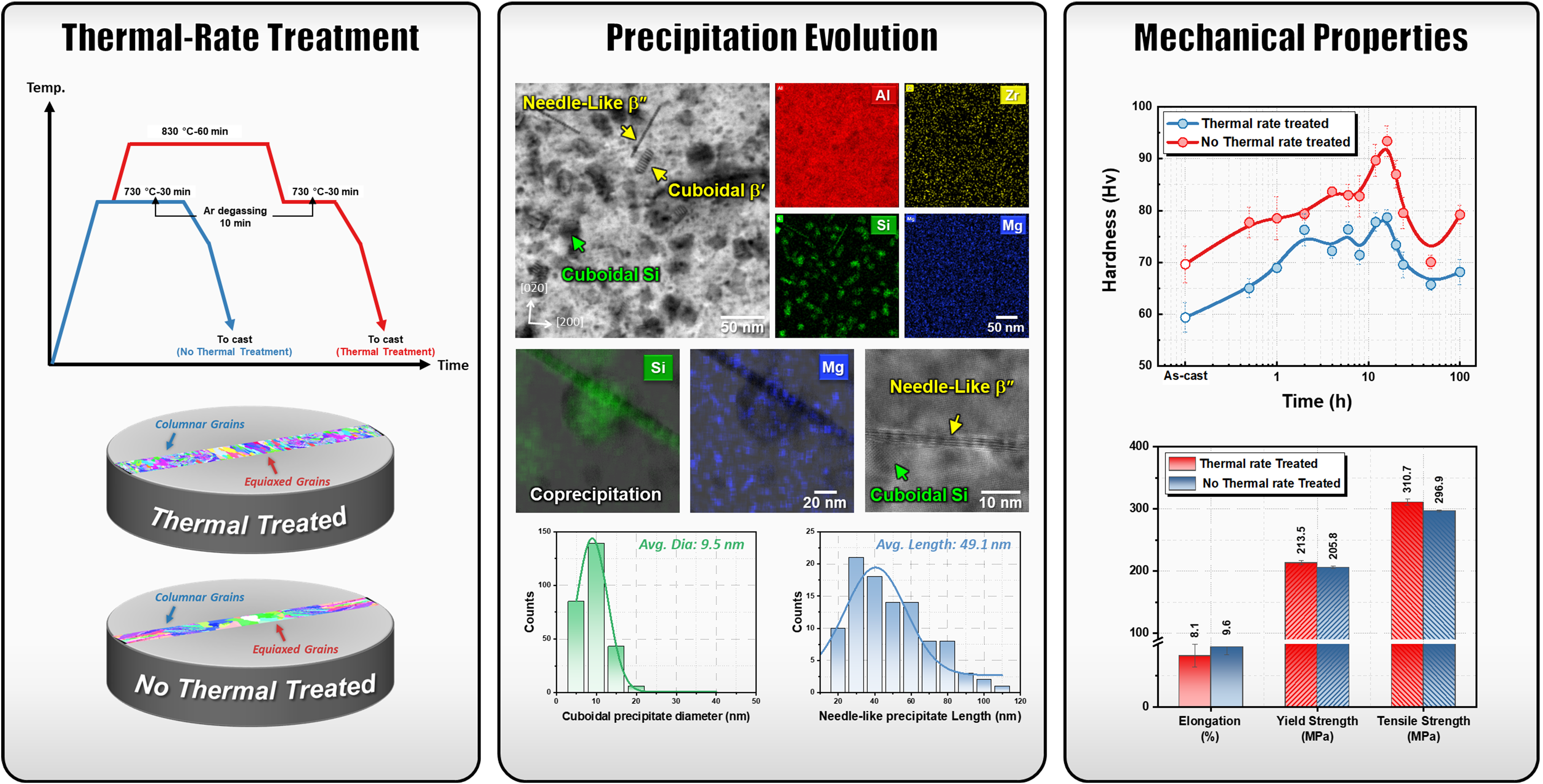
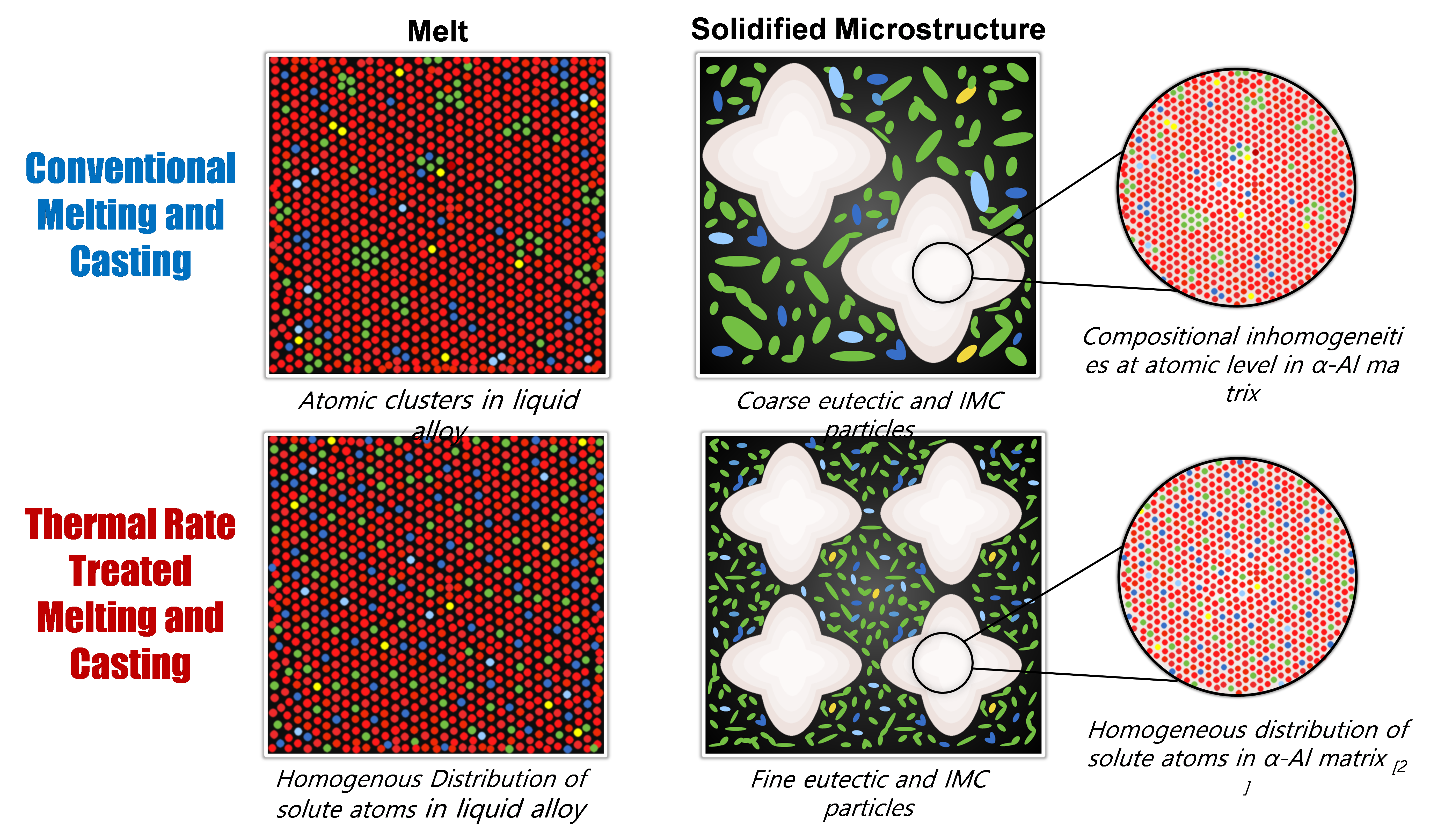
Recycled aluminum alloys often contain elevated Fe and Si, which promotes the formation of Fe–Si–rich intermetallic compounds that degrade ductility and reduce strength-elongation synergy. Melt Thermal Rate Treatment (TRT) addresses this challenge by controlling the melt’s thermal history to increase solute dissolution and improve chemical homogeneity prior to solidification. As a result, Fe–Si–rich intermetallics are refined and more uniformly distributed, while the matrix consists of a more supersaturated and uniform solute state. Consequently, an enhanced precipitation hardening during subsequent aging and translates into higher and more reliable mechanical performance, making TRT a practical pathway for upgrading high-recycled-content aluminum alloys.
Principle of Thermal rate treatment during melting
TRT offers a simple and effective approach to enhancing solute homogeneity while minimizing casting defects. TRT involves superheating the molten alloy to approximately 250–300 °C above its liquidus temperature. This process significantly increases the thermal energy of the alloy, leading to the dissociation of ordered solute clusters into individual atoms. Following this superheating, the melt is maintained at the elevated temperature for a specified duration before undergoing rapid cooling. While the breakdown of solute clusters reduces the number of effective nucleation sites, it ensures that solute homogeneity is preserved up to the solidus temperature, resulting in fewer nucleation events during solidification.
Representative Publications and Presentations
- The Effect of melt treatment on the precipitation behavior and mechanical properties of Direct-chilled cast Al-Si-Mg alloy.
Sang-Ik Lee†, Saif Haider Kayani†, Yoon-Ho Lee, Byung-Joo Kim, Jung-Moo Lee, Je-In Lee, Kwangjun Euh, Young-Hee Cho
Journal of Materials Research and Technology 33 (2024) 2704-2717.
DOI
- Melt thermal-rate treatment for uniform solute distribution and improved mechanical properties of an Al-Zn-Mg-Cu alloy prepared by direct-chill casting.
Byung-Joo Kim, Su-Hyeon Kim, Saif Haider Kayani, Yoon-Ho Lee, Won-Kyoung Kim, Hyun-Seok Cheon, Jisu Kim, Young-Hee Cho
Journal of Alloys and Compounds 967 (2023) 171745.
DOI
- Effect of Interdendritic Precipitations on the Mechanical Properties of GBF or EMS Processed Al-Zn-Mg-Cu Alloys.
Sangeun Park, Saif Haider Kayani, Hyungrae Kim, Im Doo Jung, N.S. Reddy, Kwangjun Euh, Jae Bok Seol, Jung Gi Kim, Hyokyung Sung
Crystals 11(10) (2021) 1162.
DOI
- Influence of Thermal-Rate Treatment on Precipitation Evolution and Mechanical Properties of Thermal-Rate Treated Al–10Si–0.35Mg Alloy.
Sang-Ik Lee, Saif Haider Kayani, Yoon-Ho Lee, Kwangjun Euh, Je-In Lee, Young-Hee Cho
Light Metals 2025. TMS 2025. The Minerals, Metals & Materials Series. Springer, Cham..
DOI
- Sustainable Development of Aluminum Alloys via Melt Thermal Rate Treatment.
Saif Haider Kayani, Sang-Ik Lee, Yoon-Ho Lee, Kwangjun Euh, Young-Hee Cho
The 8th International Conference on Electronic Materials and Nanotechnology for Green Environment, 2024.