Saif Haider Kayani







High-Strength Aluminum Alloys
Overview
High-strength aluminum alloys are crucial for a wide range of applications, particularly in the aerospace, automotive, and defense industries, where lightweight materials with superior mechanical properties are essential. The design of these alloys typically focuses on optimizing the composition and processing methods to enhance strength, toughness, and resistance to corrosion while maintaining good formability and weldability. Key elements such as copper, magnesium, and zinc are commonly added to achieve these properties, with careful control of microstructure and phase distribution. Advances in alloy design often involve a combination of experimental techniques and computational methods to predict the behavior of new compositions. However, traditional design approaches can be time-consuming and resource-intensive, making the need for more efficient, systematic methodologies important for achieving next-generation high-strength aluminum alloys.
Microstructure Evolution in High-Strength Aluminum Alloys
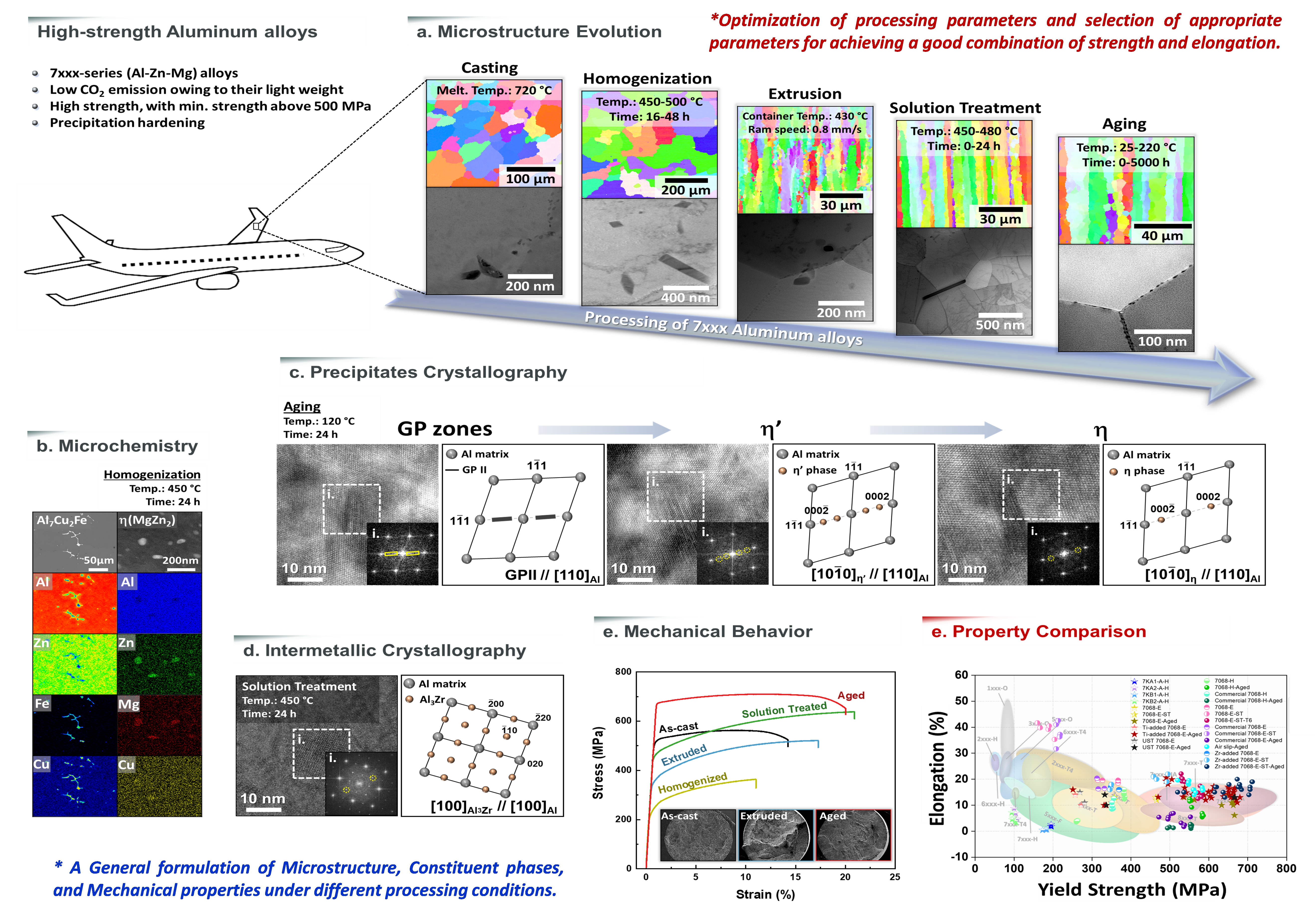
The processing of high-strength aluminum alloys plays a critical role in determining their microstructure and, consequently, their mechanical properties. A quantitative microstructure analysis reveals the impact of various processing steps:
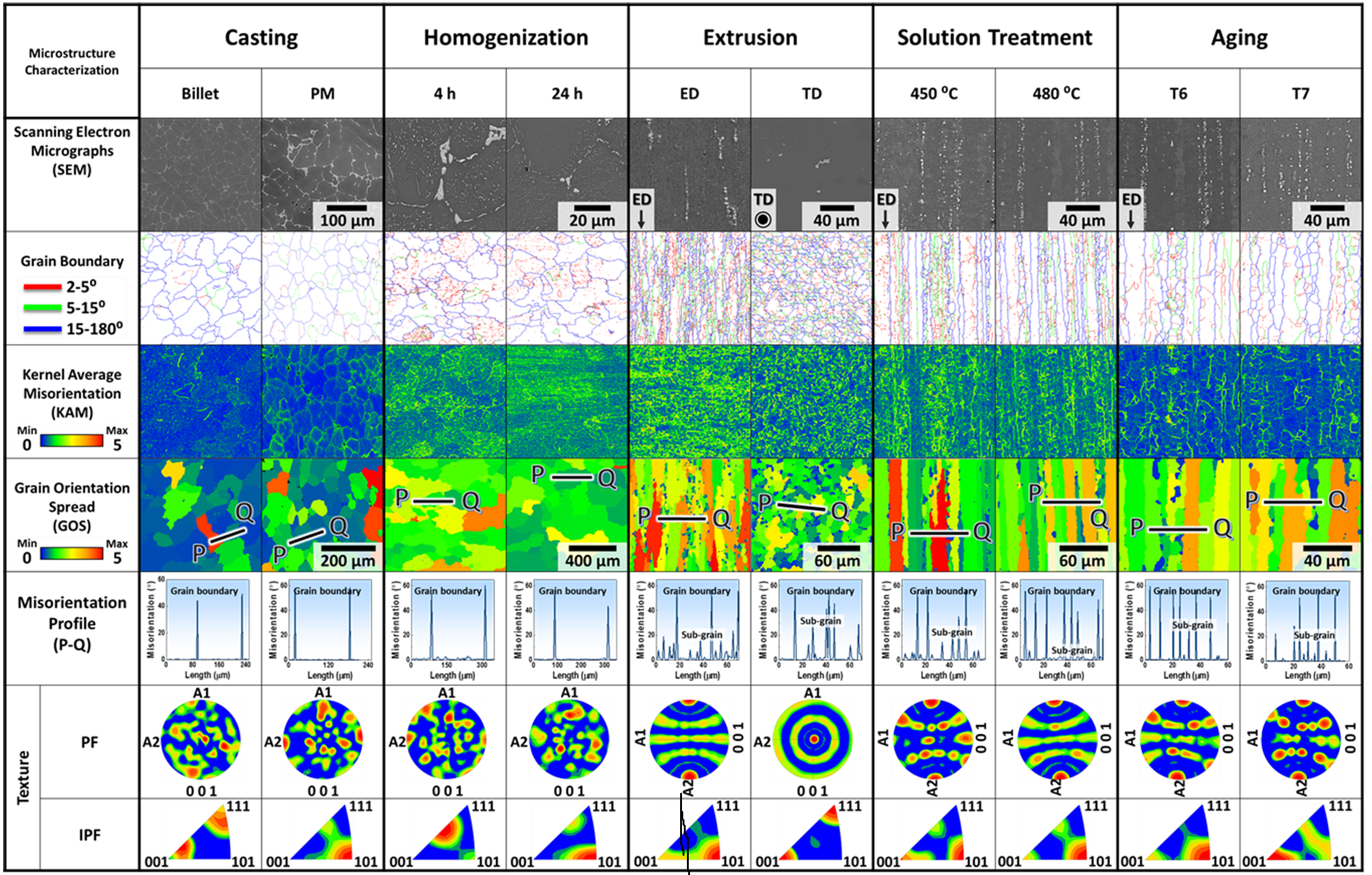
Casting: The as-cast microstructure consists of equiaxed grains with random grain orientation, and the grain boundary features large grains with a few sub-grains. Billet casting offers better grain refinement and less segregation of secondary phases compared to other casting methods.
Homogenization: Homogenization eliminates micro-segregation by modifying the morphology of insoluble particles. Performed at 450–500°C, this process refines the microstructure and reduces the size of secondary phases at dendritic interfaces. After homogenization at 450°C for 24 hours, the texture remains random, but sub-grains start to appear.
Forming: Extrusion induces crystallographic texture and anisotropy, transforming the grain structure into a pancake shape. Secondary particles break along the extruded direction, enhancing strength along the extrusion axis. This process results in high grain refinement and the presence of numerous sub-grains.
Solution Treatment: Solution treatment dissolves solute content at high temperatures, followed by rapid quenching to retain the solute at room temperature. The treatment dissolves fine particles but leaves coarse undissolved particles in the microstructure. The texture weakens slightly due to some static recrystallization during the treatment.
Artificial Aging: During aging, coarse undissolved and fine particles form, contributing to the alloy's strength. Aging treatments, typically conducted at low temperatures (100–250°C), do not significantly alter the grain structure, but precipitation evolution can be observed at the nanoscale.
Each processing step plays a vital role in refining the microstructure, enhancing material properties, and controlling the precipitation behavior in high-strength aluminum alloys.
Representative Publications and Presentations
- High Strength Aluminum Alloys Design via Explainable Artificial Intelligence.
Seobin Park†, Saif Haider Kayani†, Kwangjun Euh, Eunhyeok Seo, Hayeol Kim, Sangeun Park, Bishnu Nand Yadav, Seong Jin Park, Hyokyung Sung, Im Doo Jung
Journal of Alloys and Compounds 903 (2022) 163828.
DOI
- Effect of Cooling Rate on Precipitation Behavior of Al–7.65Zn–2.59Mg–1.95Cu Alloy with Minor Elements of Zr and Ti.
Saif Haider Kayani, Jae-Gil Jung, Min-Seok Kim, Kwangjun Euh
Metals and Materials International 26 (2020) 1079-1086.
DOI
- The role of prestraining on mechanical properties and microstructure of preaged AA 6016 Al-Mg-Si sheets-chill casting.
MinCui, Saif Haider Kayani, Hyoung-Wook Kim, Je-Hyun Lee
Journal of Alloys and Compounds 960 (2023) 170681.
DOI
- Effects of Cu additions on the precipitation activation energy and mechanical properties of prestrained Al–Mg–Si alloys.
MinCui, Yong Hee Jo, Saif Haider Kayani, Hyoung-Wook Kim, Je-Hyun Lee
Journal of Materials Research and Technology 20 (2022) 2629-2637.
DOI
- Effect of solution treatment on microstructure and mechanical behavior of precipitation-hardened Al-Zn-Mg-Cu alloy.
Saif Haider Kayani, Jae Bok Seol, Jung Gi Kim, Kwangjun Euh, Hyokyung Sung
30th International Symposium on Technology of Plasticity, 2021.